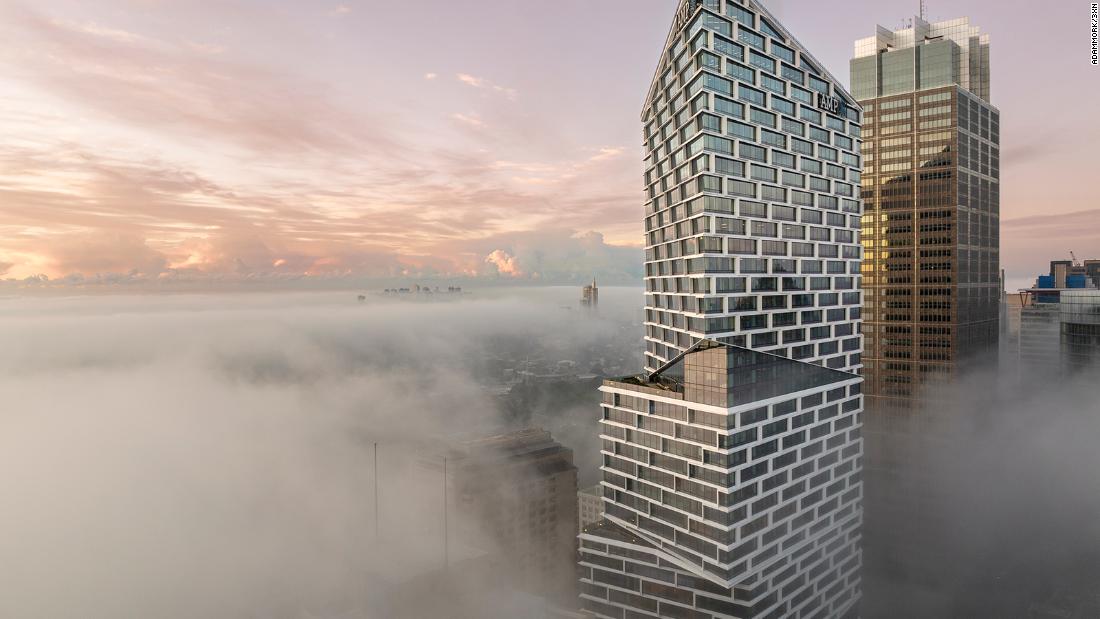
HecticArt Wonderful Architecture Work

Let's just say that I won't be moving in any time soon.

But that probably has more to do with not being able to afford a broom closet in the basement than worrying about it tipping over in a wind storm.
 
That's a cool story.
The building isn't too bad either.
Arup is the Mack Daddy of engineers. They do all of the super-cool buildings that are crazy-shaped and jaw-dropping dramatic. I'd love to have a project with the kind of budget to hire those guys.

I know about concrete shrinking (creep) and settling, but didn't think having to monitor the different rates so carefully. Most of my buildings are 5 stories or less. The engineers compensate with simple movement joints. I suppose that 10x's the size = 10x's the problems.

And concrete doesn't dry, it hydrates. (Heats up and crystalizes.) It's a hardening process that literally never stops. The concrete in the Roman buildings from 2500 years ago is still getting harder. (hehehehe)
 
And concrete doesn't dry, it hydrates. (Heats up and crystalizes.) It's a hardening process that literally never stops.
Our foundation has been pumping moisture into our basement since the house was built, but they said that it slows down at around 5 years (which we're approaching).
 
I don't remember reading that.
I've never seen that on any of my projects before.
90% sounds more like slurry than concrete.
If I can remember at work, I'll ask one of my engineers.
Are there any cracks?
 
I don't remember reading that.
I've never seen that on any of my projects before.
90% sounds more like slurry than concrete.
If I can remember at work, I'll ask one of my engineers.
Are there any cracks?
I'm an electrical engineer, I have no idea what the actual water mix is. I'm sure it's exactly the same mix as every other foundation in New England. It's just that a foot-thick, 40' x 40' foundation is comprised of a lot of water, and it continues to express moisture for some time, 4 to 5 years (according to experts). The only crack in the foundation is a vertical one right at the corner of the notch for one of the carrying sticks, which was already there when we moved in. Here's an excerpt from an article I found.

How Long Does Concrete Take to Set?​

In most cases, standard concrete (or full strength concrete) has a setting time of around one day, sometimes two days depending on the environment in which it is set. However, concrete reaches its full strength after approximately 25-28 days. You should be able to walk and perform normal tasks on concrete one week after its application. However, the concrete will only be at around 70-70% of its full strength, so driving heavy machinery on it is not advised during this time.

However, concrete will continue curing for years​

While its optimum strength is known to peak roughly a month after its installation, concrete will continue to harden and develop as time goes on. However, while concrete does continue hardening, it doesn’t necessarily benefit its structure, as it essentially becomes unnecessary.

Why does this happen?

Cement and water are mixed together (along with aggregates) to form concrete and during this, the cement particles begin mixing with the water which forms bonds. In turn, this makes the mix stronger, hardening as long as moisture is present (although, it is far slower).

Other factors that affect concrete setting time​

One of the most important factors to address in concrete hardening is the role moisture plays. Concrete needs the right amount of moisture in order to set at maximum strength. Too much water will see the concrete cure too fast, resulting in poor overall structural integrity and strength, too little and the concrete will be much harder to work into place.
 
And this is from the NPCA (I'm sure you know what that is)

Digging deeper into the curing process, hydration is the chemical process that allows concrete to go from a plastic state to a hardened state while gaining strength over time. Hydration occurs at a faster rate in the early stages after concrete placement and slows down after a month or so goes by. Many cement pastes will cease hydration before one year, and some may continue to hydrate over the course of several years (4). Because of the variable length of the hydration process, the phrase “green concrete” is a purely subjective characterization.
 
That’s what I said….. ;)

Usually concrete is dry to the touch after a day or so. If you’re seeing water come through a slab after the forms are removed it would be from ground water seeping through because there is a problem with the waterproofing or foundation drain.
 
If you’re seeing water come through a slab after the forms are removed it would be from ground water seeping through because there is a problem with the waterproofing or foundation drain.
Umm... ok. I never said anything about the foundation ever having anything but completely dry concrete surfaces at any time.

Concrete has a porosity, and so some of the water used in the concrete mix is expressed in an infinitesimally slow process that slightly raises the humidity in the basement for a few years. So we've been running a dehumidifier, but now that process seems to have stopped. So it's all good.
 
"pumping moisture" does present the image of water flowing not just higher humidity.
I was using it in the same way one would be "pumping sound" into a room. There's nothing visible either way. I'm not sure what other word I'd use.

Hectic started this with mention of how concrete "hydrates" for thousands of years. I was just trying to contribute. Silly me.
 
Vapor migration is a term we use for similar environmental events.
It's not a phrase that rolls off the tongue or makes sense to the non-nerd public.
 
Back
Top Bottom