
memebag
Top Brass, ADVP
I understand that, but that wasn't my question. When you hear it, does it rhyme with "dull"?It is laurel clear as day. No possibility to mistake it for anything else.
Sent from my iPhone6S using Tapatalk

Follow along with the video below to see how to install our site as a web app on your home screen.
Note: This feature may not be available in some browsers.
I understand that, but that wasn't my question. When you hear it, does it rhyme with "dull"?It is laurel clear as day. No possibility to mistake it for anything else.
Sent from my iPhone6S using Tapatalk

I believe (for them) the answer is yes. Again, look at the link I posted. It explains how the "L" at the end is a soft L, and is easily masked by the overtones. More importantly, it has links to the pitch-adjusted samples, allowing anyone to hear both results. So instead of repeatedly asking what other people hear, or claiming that it's "clearly" one way or the other, or that it has to do with your speakers or playback device, just listen to the samples.I understand that, but that wasn't my question. When you hear it, does it rhyme with "dull"?
I believe (for them) the answer is yes. Again, look at the link I posted. It explains how the "L" at the end is a soft L, and is easily masked by the overtones. More importantly, it has links to the pitch-adjusted samples, allowing anyone to hear both results. So instead of repeatedly asking what other people hear, or claiming that it's "clearly" one way or the other, or that it has to do with your speakers or playback device, just listen to the samples.
I know, I hear exactly the same thing as you. The importance of the L sound being soft, is that it's more easily masked by the overlayed sound, which sounds like an E. So we only hear the overlay sound, which masks the L sounds at both ends, to make them sound like "E"s to us.I read the link you posted, but it doesn't help me understand. I don't hear anything like an "l" sound at the end, soft or hard.
Thanks for the compliment on the wife, but your dickishness almost made me scrap posting the solution to all this. The following article by a linguist, contains pitch-shifted versions of the audio. I clearly hear the difference, I imagine all of you will too.
A Linguist Explains Why 'Laurel' Sounds Like 'Yanny'

Then you're either just being intentionally difficult for the sake of argument (high probability), or you have some seriously fukd-up hearing. According to the experts, the recording is of the word laurel, so it's there to be heard.I listened to the pitch shifted versions. All of them sound like "yarry" to me. There is no "ull" sound at the end no matter what speed it is played at. Always an "ee" sound.
Then you're either just being intentionally difficult for the sake of argument (high probability), or you have some seriously fukd-up hearing. According to the experts, the recording is of the word laurel, so it's there to be heard.
My daughter has a medical condition that likely contributes to her high frequency sensitivity, but even she hears laurel at 30% pitch shifted up. If you don't, that probably means that the overlaid frequency is still masking the recording for you. I imagine if that's the case, you'd be aware of having a strong sensitivity to high frequencies.
Yes, exactly. At both 20% and 30% pitch shifted up, I hear lar-ull or lar-ell. My daughter hears sort of a hybrid at 20%, but hears laurel at 30%. What I hear in those samples is what I assume many people hear at the original pitch.So you hear an "ull" sound at the end of the recording at some speeds?
I don't hear any of the timbres involved in an "ull" sound. It's all "ee", all the way to the end.Yes, exactly. At both 20% and 30% pitch shifted up, I hear lar-ull or lar-ell. My daughter hears sort of a hybrid at 20%, but hears laurel at 30%. What I hear in those samples is what I assume many people hear at the original pitch.
Dude, you're repeating yourself. If your ear hears the overlaid frequency that's masking the main frequency, you'll only hear "ee", not "ull". It's not like they start morphing. It's either masked, or not.I don't hear any of the timbres involved in an "ull" sound. It's all "ee", all the way to the end.
OK. Does that bug you?Dude, you're repeating yourself. If your ear hears the overlaid frequency that's masking the main frequency, you'll only hear "ee", not "ull". It's not like they start morphing. It's either masked, or not.
OK. Does that bug you?
I'm not saying I'm right, just describing my subjective experience.
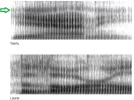
These aren't simple frequencies; they are timbres. There is no "main frequency" or "overlaid frequency", just a collection of frequencies changing over time.
But then ...
Someone applied a steep cutoff filter that makes it all clear:
Cut out frequencies below 2k and it sounds like "yeahwee". Cut out frequencies above 2k and it sounds like "laurel".
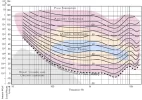
If you have good, young ears you should be able to hear the frequencies about 2k.
Now I'm saying I'm right.
That's a good clip. And it does exactly the same thing as the pitch shifting, but in a cleaner, more absolute way.
With meme video post showing both. I can partially hear yanny but it still sounds like laurel to me.

