


Construction
- Thread starter JHDK
- Start date
You are using an out of date browser. It may not display this or other websites correctly.
You should upgrade or use an alternative browser.
You should upgrade or use an alternative browser.

The dude came back, couldn't see anything wrong and turned the thing back on. It started out not smoking but then the amount of smoke started growing. Nowhere near what it was the day before but still too much. It's not coming out of the exhaust, there is oil or something gathering and then burning off. The guy is now in touch directly with Generac.


Wolf
AI is here, time to obey our robot overlords!


Returned the generator on Amazon. It made me speak to someone first. I explained the situation. The lady said she had to speak to a supervisor. I sat on hold for probably 10 minutes. She came back and said my return was approved. $3300 refunded. I don't have to return the unit, but I have to get rid of it because I don't trust it. I'm not giving it to a friend because I don't want to be responsible for their house catching fire someday.
I've had nothing but excellent experiences with Amazon's return. Back in 2001, I bought a Samsung DVD player that had a built-in gaming console. It didn't work. Samsung was ZERO help. I returned it, got another, it didn't work also. Again Samsung was useless. After speaking with someone at Amazon, we agreed I'd try a third one. It also didn't work right. I was able to return all 3 with zero problems. I didn't buy anything Samsung for FIFTEEN YEARS after that (I'm a vengeful prick when I wanna be - ask me about Sears or Mobil...), but I've spent probably tens of thousands at Amazon since.
Oh, and Samsung gave up on their horrible DVD/gaming combo.
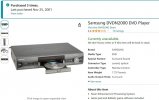

I've had nothing but excellent experiences with Amazon's return. Back in 2001, I bought a Samsung DVD player that had a built-in gaming console. It didn't work. Samsung was ZERO help. I returned it, got another, it didn't work also. Again Samsung was useless. After speaking with someone at Amazon, we agreed I'd try a third one. It also didn't work right. I was able to return all 3 with zero problems. I didn't buy anything Samsung for FIFTEEN YEARS after that (I'm a vengeful prick when I wanna be - ask me about Sears or Mobil...), but I've spent probably tens of thousands at Amazon since.
Oh, and Samsung gave up on their horrible DVD/gaming combo.
Glad they took care of you.
From the sound of it, I’m guessing that there’s a bad gasket or crack in a manifold or something that’s seeping oil. Best to scrap it. Maybe you can get some $ at a scrap metal recycling place.
I hold grudges like that too.
I’ve had great luck with Samsung stuff, but had to prove a point with Amazon over a broken bottle of guitar cleaner. That saga is posted around here somewhere.
From the sound of it, I’m guessing that there’s a bad gasket or crack in a manifold or something that’s seeping oil. Best to scrap it. Maybe you can get some $ at a scrap metal recycling place.
I hold grudges like that too.
I’ve had great luck with Samsung stuff, but had to prove a point with Amazon over a broken bottle of guitar cleaner. That saga is posted around here somewhere.

How does that work? They're out a lot of money. We've had situations where they send a replacement, and will say "don't bother returning the defective item", but I don't think I've ever heard of someone saying "just keep that $3,000 item, it's on us". You've got to wonder what the profit model is, if they can afford to do that.She came back and said my return was approved. $3300 refunded. I don't have to return the unit, but I have to get rid of it because I don't trust it.
I also wonder what happened to the service guy who called Generac. I guess at this point nobody cares anymore (because you got a refund)?
When we were getting ready to sell our house in NH, we replaced a bunch of kitchen appliances with LG stuff. And in particular, the dishwasher was just a flawed design. The main circuit board in the top of the door would get shorted-out by water. We had to have it replaced a couple of months after we got it. And going through the company to get service was really difficult.
But the kicker came a couple of days after the closing, when it broke again. And we couldn't get the company to understand that we sold the house, and therefore was no longer involved with repairs. They insisted that since we purchased it, we were the ones covered by the warranty (not the appliance). So Mrs. Scotch had to meet the service guy at the house we sold, which involved making arrangements with the people we sold it to (very awkward). That's why, when we bought our OLED TV last year, we wanted the Sony, not the LG. But the panels are all made by LG anyway, and (for these TVs at least) they have a much bigger service network.

IdRatherBeSkiing
Sherbert is NOT and NEVER WILL BE ice cream.
I worked at Service Merchandise back in the late 80's, and some of the defective products that we'd get had instructions from the manufacturers to discard/destroy. By the time you ship it back to them and add that cost along with the cost for them to either repair or ship back to the factory to be refurbished, they can's make enough money for it to be worth their while.
Generac probably expects to make $700 profit off of a $3000 generator. That disappears quickly with all of that handling for a return.
Generac probably expects to make $700 profit off of a $3000 generator. That disappears quickly with all of that handling for a return.
Not sure. But I'm very happy with Amazon for understanding. I've been through enough hell. So glad they have my back.How does that work?

Of course you did.I worked at Service Merchandise back in the late 80's
IdRatherBeSkiing
Sherbert is NOT and NEVER WILL BE ice cream.
So writing off the full $3000 is better? It's like the old saying where someone is losing $1 / item and is asked how they plan to make up for the loss? And the answer is volume!I worked at Service Merchandise back in the late 80's, and some of the defective products that we'd get had instructions from the manufacturers to discard/destroy. By the time you ship it back to them and add that cost along with the cost for them to either repair or ship back to the factory to be refurbished, they can's make enough money for it to be worth their while.
Generac probably expects to make $700 profit off of a $3000 generator. That disappears quickly with all of that handling for a return.
IdRatherBeSkiing
Sherbert is NOT and NEVER WILL BE ice cream.
They probably offered free dougnuts as as a perk.Of course you did.
It was shortly after high school. I was hired to sell electronics before they were done with construction. They put me to work in the warehouse to help build displays and stock the sales floor before they were open for business. Then they had me work both electronics and the warehouse. One of the things I was in charge of was dealing with damaged and defective merchandise. A lot of stuff went back the the manufacturer, but some stuff we were supposed to destroy or just throw away because it was more costly for the manufacturers to fix.Of course you did.
Something like Generac, I assume that it would get shipped to Generac and would have to get shipped overseas to get back to the factory where it was built. Factories like that usually don't have facilities for repairs. Time to troubleshoot, individual parts, bench testing, re-packaging, shipping back to the states, and then having to sell it on the cheap as a refurbished unit all adds up a big loss. You ask why they don't have service centers locally? I'm guessing it's just about overhead with higher labor rates and facility costs. The write-off is probably cheaper.
No. I was young and didn't know how to negotiate.They probably offered free dougnuts as as a perk.
I had to pay for snacks out of the vending machines like everybody else.
I don't know what kind of a mark-up they have on those things, but common retail pricing is called keystone and it's pretty typical. If a retailer sells something for $3000, they probably bought it from the manufacturer for $1500. The manufacturer probably paid $750 to make it and expected to make $750 for their profit. With all of that handling, their $750 profit disappears very quickly for a repair.So writing off the full $3000 is better? It's like the old saying where someone is losing $1 / item and is asked how they plan to make up for the loss? And the answer is volume!
Everything doesn't use that model. Jewelry for instance can have a 300% mark-up. I think it's because they don't sell a lot of volume and still need to pay their staff and overhead.
IdRatherBeSkiing
Sherbert is NOT and NEVER WILL BE ice cream.
It just seems strange to accept a writeoff/loss of $3000 even though the cost of return would definitely eat away at the profit margin. I guess they must have the $3000 cost worked into the price to make it not hurt the bottom line.I don't know what kind of a mark-up they have on those things, but common retail pricing is called keystone and it's pretty typical. If a retailer sells something for $3000, they probably bought it from the manufacturer for $1500. The manufacturer probably paid $750 to make it and expected to make $750 for their profit. With all of that handling, their $750 profit disappears very quickly for a repair.
Everything doesn't use that model. Jewelry for instance can have a 300% mark-up. I think it's because they don't sell a lot of volume and still need to pay their staff and overhead.
IdRatherBeSkiing
Sherbert is NOT and NEVER WILL BE ice cream.
Manufacturer out $750 for cost as well + overhead.The manufacturer was only expecting to make $750.
It's probably more expensive for them to fix than they would make, so it's a write-off at that point,
IdRatherBeSkiing
Sherbert is NOT and NEVER WILL BE ice cream.
But they could likely disassemble it for parts or raw materials.It's probably more expensive for them to fix than they would make, so it's a write-off at that point,