Miscellaneous News Thread

No it doesn't. Shifting the pitches doesn't remove them, not unless you shifted the 2k frequencies above 8k or so. That would be a 400% speed increase.
What a tool; you can't even allow someone to agree with you. :clap2:

I never said that shifting the pitches removes them. It changes the relative sentitivity, that's all that's needed. Maybe you should read something about hearing and masking, because I've said the same thing 5 times now, and you're not getting it. With masking, the original sound is obscured by a louder sound, even if it is only slightly louder. No need to remove them, just change the relative loudness.
 
Then you aren't hearing the high frequencies. Here's a hearing test to find out which frequencies you can't hear:


That was an interesting cool test. Since I am at work and using Apple Airpods. I did a couple of test on myself, I set the volume at 25, 50, 75 and 100 percent.

25% - 107Hz
50% - 53Hz
75% - 41 Hz
100% - 31Hz

I normally like to set my headphone range around 30-40%.

I could do it without the headphones, but I have people around me talking and some music playing. So I'll do it tonight when I am at home where it is much quieter.

I don't understand these Hz to Khz, so I just googled it.

"People can hear sounds at frequencies from about 20 Hz to 20,000 Hz, though we hear sounds best from 1,000 Hz to 5,000 Hz, where human speech is centered. Hearing loss may reduce the range of frequencies a person can hear. It is common for people to lose their ability to hear higher frequencies as they get older"
 
Last edited:
What a tool; you can't even allow someone to agree with you. :clap2:

I never said that shifting the pitches removes them. It changes the relative sentitivity, that's all that's needed. Maybe you should read something about hearing and masking, because I've said the same thing 5 times now, and you're not getting it. With masking, the original sound is obscured by a louder sound, even if it is only slightly louder. No need to remove them, just change the relative loudness.

You didn't say shifting pitches removes them, you said the inverse, that removing frequencies does the same thing as pitch shifting:

That's a good clip. And it does exactly the same thing as the pitch shifting, but in a cleaner, more absolute way.

The clip you're referring to removed the frequencies, which isn't "exactly the same thing as pitch shifting". I still hear the high frequencies when they are shifted up. They are still masking the low frequencies. The low frequencies were not removed.
 
You didn't say shifting pitches removes them, you said the inverse, that removing frequencies does the same thing as pitch shifting:


The clip you're referring to removed the frequencies, which isn't "exactly the same thing as pitch shifting". I still hear the high frequencies when they are shifted up. They are still masking the low frequencies. The low frequencies were not removed.
I was referring to the effects, not the procedure. I thought it was obvious that the procedure was different, because if they were the same, then there would just be one thing.
 
I was referring to the effects, not the procedure. I thought it was obvious that the procedure was different, because if they were the same, then there would just be one thing.
I'm referring to the effects, too. Pitch shifting doesn't remove frequencies unless you pitch shift outside the range of human hearing, and the samples in that post don't do that.
 
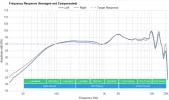
Not a waste of time for frequencies between 100Hz and 10kHz on those earphones.
That big bump at 2kHz says otherwise. And unless you did an in-room (or in-ear) spectral analysis of your particular speakers, you're wasting your time. Go to an audiologist and get a hearing test. They compensate for the SPL variations of the speakers.

I'm referring to the effects, too. Pitch shifting doesn't remove frequencies unless you pitch shift outside the range of human hearing, and the samples in that post don't do that.
For the 6th time: masking.
Masking.
Masking.
Masking. Masking. Masking. Masking. Masking. Masking. Masking. Masking. Masking. Masking. Masking. Masking. Masking. Masking. Masking. Masking. Masking. Masking. Masking. Masking. Masking.
 
Makes me curious, if we're all hearing this one audio recording differently... what else are we hearing differently.
 
That big bump at 2kHz says otherwise. And unless you did an in-room (or in-ear) spectral analysis of your particular speakers, you're wasting your time. Go to an audiologist and get a hearing test. They compensate for the SPL variations of the speakers.

He can use that video to find the upper limits of his frequency range. I thought that was clear by the way I worded my post.

For the 6th time: masking.
Masking.
Masking.
Masking. Masking. Masking. Masking. Masking. Masking. Masking. Masking. Masking. Masking. Masking. Masking. Masking. Masking. Masking. Masking. Masking. Masking. Masking. Masking. Masking.

Pitch shifting doesn't mask frequencies, either.
 
During a solar eclipse, has the sun been removed, or is it still there, and merely blocked temporarily by the moon?

The light has been blocked. In the video I posted the frequencies were removed by the filter. Frequency masking doesn't remove any frequencies. The brain fails to register some of them, but they are still there.
 
Makes me curious, if we're all hearing this one audio recording differently... what else are we hearing differently.
Apparently, the sound of logic.

Pitch shifting doesn't mask frequencies, either.
Masking is the entire principle behind the whole yanni/laurel phenomenon. For some people, the (higher) frequency component that makes it sound like "yanni" is dominant. For others, that same frequency is not noticeable over the (lower) frequency components that form "laurel". Pitch shifting simulates the difference in people's hearing perception.

While using an extreme high-pass/low-pass filter yields a clear and reliable result, it doesn't properly represent what's going on between what people are hearing.
 
Apparently, the sound of logic.


Masking is the entire principle behind the whole yanni/laurel phenomenon. For some people, the (higher) frequency component that makes it sound like "yanni" is dominant. For others, that same frequency is not noticeable over the (lower) frequency components that form "laurel". Pitch shifting simulates the difference in people's hearing perception.

While using an extreme high-pass/low-pass filter yields a clear and reliable result, it doesn't properly represent what's going on between what people are hearing.
We disagree.
 
Back
Top Bottom